At the start of the semester I didn't know what to make of Rhetor Rick and all of the potential knowledge and wisdom he had to offer. Now that we've reached the end of the semester I see that he could, even on his worst day, put both the Dos Equis man and Chuck Norris to shame.
I have taken numerous English classes, logic classes, and psychology classes, but this class will stand out among them in the way something ancient, appealing, and beautiful sticks out from the ordinary and familiar. It's clear that rhetoric has always been present, but that I have simply not had the tools or knowledge to see it. Now, perhaps, when arguing or being presented with an argument, I won't be caught off guard without knowing what hit me or how the blows occurred. It's clear that it will be useful in my speaking and writing, and it is also clear that I have a lot of work to do (lifelong work) to truly hone and appreciate its power, maximize its effects, and use it in the right situations with ethics in check.
Though my posts will stop with this post as the semester comes to a close, cheers to you, Rhetor Rick! I've been glad to be your disciple this semester.
In closing, please accept this deliberate attempt to divert you from my post as a token of my appreciation:
This is a question that provokes further questions that will be explored in this post. If the ‘experience’ is that of the author who is trying to share the entirety of their experience with a reader, then language is not powerful enough to capture and share the entirety of it – just like how the human brain is not equipped to handle the entirety of sensory ‘experience’ that the universe consistently churns out. I ate a big bowl of Cheerios with banana slices and skim milk this morning. If I wanted to share that experience from the first crisp bite of Cheerios to their soggy finale, then I would fail in trying to pass this experience on to my reader. They might get hungry, but they wouldn’t come close to being able to recreate it without getting their own bowl of Cheerios, a banana, and some skim milk and creating a similar experience for themselves. Good authors are probably the ones that can get very close to recreating these sensory experiences in the mind of their readers, but language is still not powerful enough to evoke all of the senses or all of the potential in our brains.
But in this regard the question is a bit silly and obvious, so I will move on to what I feel is a more interesting or reframed approach to this question.
Which experience is more valuable? Is it the original author's intended attempt to share his or her experience, or is it the experience that the reader creates for themselves? With language something is always obfuscated or hidden and not what the author truly implied. The reader picks up that story and changes it for themselves based on their own experiences. Language, then, becomes the cut and paste enabler of new, created experience that is malleable, testable, and even more powerful when put together and interpreted in the human brain. The reader allows his or her own experiences to affect the experience they have with the author’s text. In a way, this “disadvantage” or shortcoming of language allows for the “good stuff,” the malleable creation of the individual mind that warps the real story, the real experiences, and creates. When Dostoevsky died, the true “experience” he meant to convey died with him, but his language continues to live through the new sensory experience invoked by his text in the reader. Thousands of essays interpret different portions of his language trying to find new meaning or interesting interpretations, and in their subjectivity there is no right or wrong experience, just a personal one.
Thus, I would argue, that while language cannot capture the every detail, feeling, and thought that goes into someone else’s experience, this creation of a new experience for the reader using language then becomes the most important experience that transcends the original and can be captured in its entirety and then reshaped into new language for the next person to create their own fully captured experience.
At times there seems to be overwhelming use of pathos in everyday life but I feel like that's what our society calls for. Everyone wants their message to be heard. The easiest way of doing that is through emotion. Trying to truly connect with someone else and getting them to understand your message. When it gets to be excessive is when the fallacies come into play. People want to go so far as to scare others into believing the claims that they are making. Tabloids often make extreme accusations in order to get the attention of the public. This works on a lot of people because they are drawn into the claims that are being made. Whether it be because of fear, disgust or excitement. If someone makes a claim that the world is going to come to an end, there is going to be excitement around the subject. This would draw reader in and then they would inevitably see the adds for other stories and products. I feel like these are the cases when using the pathetic is too much. Overall though, I feel like the pathetic discourse in our society does add to our culture and allows us to connect on a deeper level.
In all honestly, though public discourse has become more and more pathetic, I do not believe that public discourse has become too pathetic. This is primarily due to the fact that emotions are what interest us. Unless reading for the facts, people don't typically read a book unless it is full of emotion and things that draw our attention. So people over-exaggerate a little. So they make something out of nothing and at times make viewers and readers everywhere a little crazy. The problem is--the media does this because the people crave it. This may be a hard truth to face but it is also a hard truth to deny. Whether you are reading a book, listening to a speech, or hearing the news, emotion and pathos need to be involved. As horrible as it is, we are drawn to these appeals by nature. That being said, the receivers are to blame just as much as the presenters and if public discourse attempts to become less pathetic, well, everyone is going to be a little disappointed.
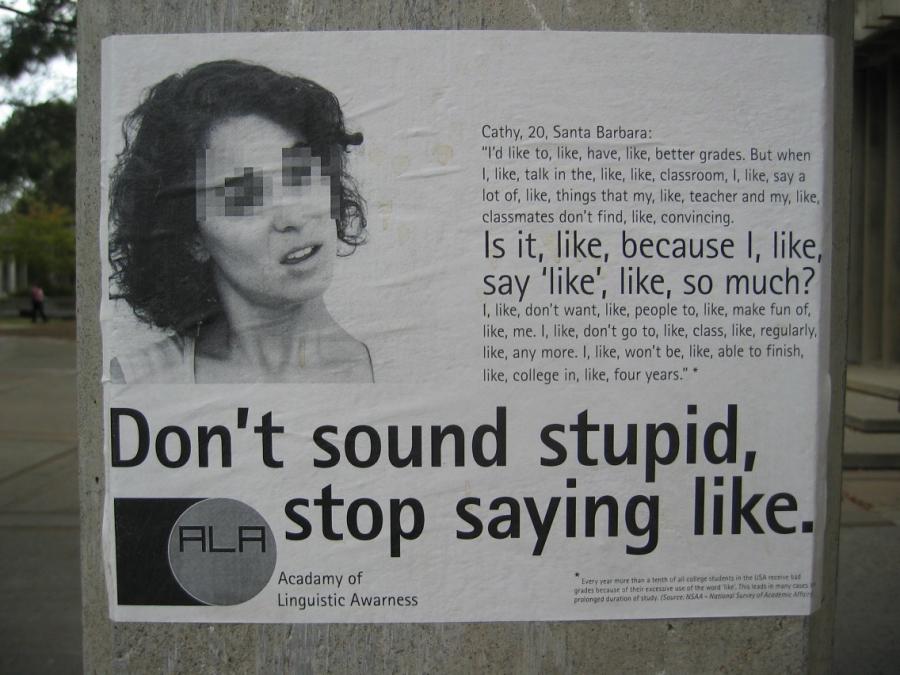
It's okay, we're all guilty of this one. It's highly contagious and hard to shake, and a lot of people don't even realize how they use the word 'like' as a vocalized pause until they hear a recording of their conversation played back to them. I think it's especially funny that searching for "the word like" on Google lands you on pages that discuss how to permanently remove this nasty one from your vocabulary for good.
I apologize in advance if this post causes you to start counting or focusing on how many times people you are listening to use 'like' in their sentences.
Many people, including myself, associate 'like,' when used as a vocal pause as a replacement for "uh", "um", and other weird things we say when we are pausing to think about what to say next, with teenager or childish methods of communication. Excessive use of this word has negative connotations that reach back to that of Shaggy on "Scooby Doo" or the Valley girls in the movie "Clueless." Luckily, it has not yet worked as well on paper as it does in contemporary conversation. Consider the following examples of this word abuse:
1) And then I was like, "no way!"
2) That's like near State Street.
Would you take an article seriously if they wrote their thoughts like this? In the first example, "was like" replaces "said" or "screamed" or some verb that would give this sentence meaning. It doesn't make any sense! How did you resemble "no way" in any shape or form? In the second example, we see that 'like' can be omitted without any consequence. It really has no place in the sentence at all.
So why is 'like' so popular? Why has it become such a habit? There are interesting theories that say that today's youth never like to express their thoughts concretely, preferring instead to soften their expressions using a "fuzzy" word such as 'like.' Personally, I tend to use the word in this way when I get excited about an event that occurred and try to explain it to a group of friends as quickly as possible. I have also been told that when I am consciously trying to not say 'like' I sometimes come across as too serious or even suspicious, which makes this pet peeve even more of a mystery, since most dignitaries or orators never seem to let the word seep into their language.
I guess the real question is: will the baby boomer who might be your future boss appreciate how well your conversation matches that of a Valley girl? Don't get me wrong, Shaggy is a pretty cool cat, but we all know that hippie never got a real job!
A phrase that I once enjoyed using was the phrase “all about” when talking about liking something. For example, A few years ago I was all about using that phrase. Then this past weekend I ran into someone who made the “all about” phrase a victim of terrible overkill.
A friend of a friend brought one of their friends over to my apartment at 3 in the morning while all of the people that I live with were watching a movie as the night was coming to an end. This friend was obviously feeling drunk and was incredibly obnoxious. He commenced to play a game of beer pong with my roommates and I. I never asked his name nor really cared because I noticed very quickly that every other sentence he said included the phrase all about. He tried to make awkward conversation such as, “Let’s play beer pong. I’m all about beer pong.” Then he went on to say that he is “all about making cups” when he plays beer pong (oddly enough the objective of the game). But then we started to stray from the game and tried to make friendly conversation with this guy. I am “all about” giving a person a second chance, even if they initially rub me the wrong way. At this point I had already noticed his bad habit, and I texted my roommates so that they could realize and enjoy his subconscious language addiction. In a ten minute conversation, he went on to tell me how he was “all about” the Ying Yang Twins, “all about” eggrolls, and “all about” Tommy Boy to name a few.
My roommates and I just burst out with laughter as he proceeded to say that he was “all about” everything under the sun over 20 times in ten minutes. He was a very interesting guy with plenty of good things to say, but I couldn’t help but to concentrate on what quickly became a pet peeve of mine. No matter how good a phrase is or you think it may be, don’t overuse it. Popular and trendy phrases are great to have in your syntactical arsenal, but make sure to use them in moderation.
This was a thought provoking article for me. While reading it, I noticed that everything that the article is saying is relatively true. People easily remember things that flow better. It makes sense that big name firms would choose a name that has a ring to it because that way they stay in the customer's head, even if the customer doesn't know it. Something that was interesting to me was that people conducting studies found that even the font had an affect on people answering different questions. It was also interesting that although things that are more fluent are more familiar to us, they can also get boring. This raises some interesting questions as to how much fluency one should use in choosing a name.